
Índice de contenidos
You can bring together 2,000 professionals, set aside an hour for networking and prepare the best coffee break in the world. But if someone is looking for distributors to enter a new market and ends up spending twenty minutes talking to someone who has nothing to do with that goal, something has gone wrong.
Because networking is not about exchanging as many contacts as possible. It is about making sure the conversations that happen during the event are relevant to the people taking part. And that is where matchmaking comes in: using information about attendee profiles, interests and goals to reduce some of the randomness and increase the chances of creating relevant connections.
But how does it actually work? And what makes a good matchmaking system different from a packed meeting schedule with very little real logic behind it? Keep reading to find out!
What is event matchmaking and how does it improve networking?
Event matchmaking is a system that connects attendees based on specific compatibility criteria, such as their industry, professional profile, needs, or what they are looking for and can offer. The main difference compared with more spontaneous networking lies in what happens before the conversation starts.
In a traditional networking setting, attendees decide who to speak to on the spot. That still has value and should not disappear: some of the best conversations at an event begin completely unexpectedly.
Matchmaking is not designed to replace that. What it does is reduce the role of chance when there is a clear networking objective. Imagine, for example, a B2B event with buyers, suppliers and investors. Instead of hoping each attendee happens to meet the profiles they are interested in, the planner can collect information beforehand about what each person is looking for and use it to suggest 1:1 meetings with a stronger level of fit.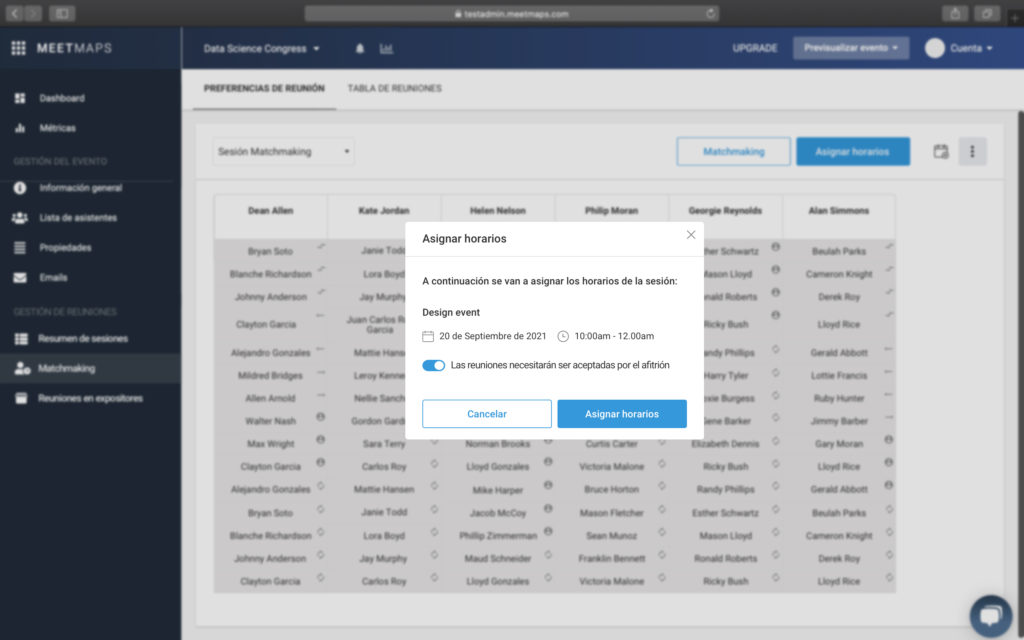
That means networking moves from “Let’s see who I manage to speak to” to “These are the people it could genuinely make sense for me to meet.” And that small shift matters. Especially at events where a significant part of the perceived value depends on business opportunities and connections between attendees.
Today’s matchmaking systems work precisely with profiles, needs and goals collected in advance to structure meetings, rather than leaving all interaction entirely to chance.
How does event matchmaking work?
Although every event may approach it slightly differently, an event matchmaking process usually follows a fairly clear sequence:
Profile → Preferences → Match → Schedule → Meeting → Feedback
And what is interesting is that the work begins well before attendees arrive at the venue.
1. Collect information about attendee profiles
Everything starts with registration. Alongside basic attendee details, the form can collect information that will later help create better connections: industry, job title, interests, goals, or even what the participant can offer to others.
2. Match interests, preferences and rules
With that information, matchmaking software can compare profiles and identify potential affinities according to the criteria defined for the event. There is an important distinction here: it is not simply about finding people who are “similar”. In some events, the exact opposite is what creates value.
A buyer may want to meet suppliers. A startup may be looking for investors. A company planning international expansion may need distributors in specific markets. So, beyond attendee interests, the planner can establish rules around who can meet whom, apply segmentation or block certain combinations.
3. Build the meeting schedule
Once potential connections have been identified, one of the most time-consuming parts begins if it is managed manually: turning those potential matches into a workable meeting schedule.
Preferences, availability, time slots, spaces and potential conflicts all need to be taken into account. 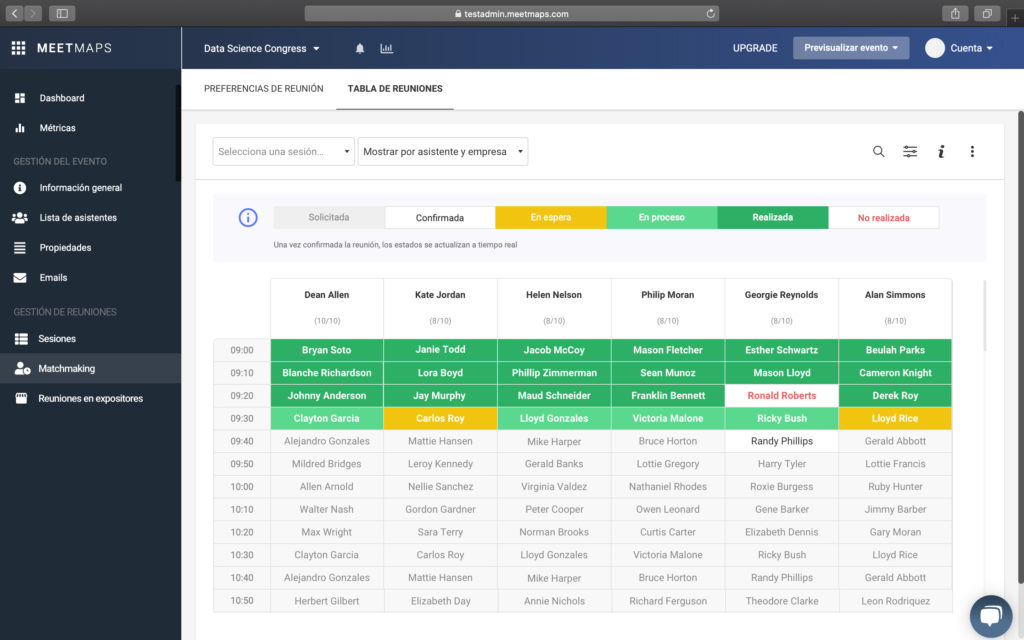
With an automated matchmaking system, much of this networking process can be managed directly from the platform to generate a preliminary meeting schedule. The planner can then review it, make changes and remain in control before publishing it.
And this is important: automation does not mean giving up decision-making power.
Technology can solve the operational puzzle, while the organiser still defines the rules of the game. In fact, specialised platforms such as Meetmaps allow automatic assignments to be combined with manual adjustments to schedules, participants or locations.
4. Make meetings easier during the event
When event day arrives, each attendee can consult their personal schedule with all planned meetings, including times and assigned locations. If anything changes, updates can be reflected automatically in the schedule, avoiding the need to manage changes across spreadsheets, emails and last-minute messages.
In addition, networking meetings can take place face to face or, depending on the event format, through video calls. Technology does not need to do anything particularly flashy here. It just needs to do something very important: make sure nobody has to wonder where they need to be, who they are meeting and at what time.
5. Measure what happened afterwards
This is one of the biggest differences between organising networking and simply providing a space where it might happen. 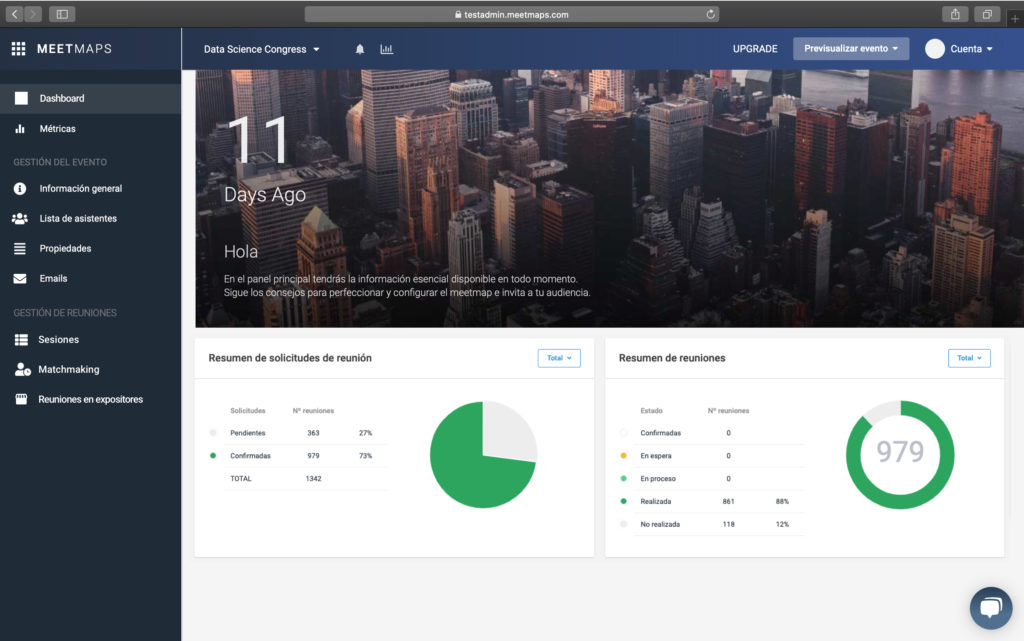 If the process is digitalised, the planner can later analyse the data and metrics to understand what happened with the proposed meetings: how many were requested, accepted, completed or rejected, where no-shows occurred and how participants rated them.
This makes networking measurable and allows organisers to use the results to refine matchmaking rules for future editions. Platforms of this kind already make it possible to track requests, accepted meetings, completed meetings and absences.
How can you make event matchmaking truly effective?
Automating the process helps, but having an algorithm does not guarantee high-quality networking on its own. In fact, a matchmaking setup can be technically flawless and still generate meetings that are not particularly relevant. There are four areas that make a real difference.
1. Match quality starts with the data
There is a fairly simple rule: Poor profile = poor recommendation.
If all you know is that Carlos works in “Marketing” and Laura works in “Technology”, you have very little information to decide whether they should meet.
The better you understand what each attendee is looking for, what they can offer, what their interests are and what they hope to achieve by attending, the more context the system has to suggest meaningful connections. That is why the design of the registration form is part of the matchmaking process. It is not something separate.
That said, registration should not turn into a twenty-minute interview either. The key is to ask only for the information you will actually use to create better connections later on.
2. Not everyone needs to be able to meet everyone
More options do not always mean better networking. At certain B2B events, it may make much more sense to establish relationships such as:
Buyers ↔ Suppliers
Startups ↔ Investors
Recruiters ↔ Candidates
rather than allowing every possible combination.
The planner can define these rules, segment participants and even use blocklists when certain profiles should not be matched with one another.
This reduces irrelevant requests and makes it possible to design networking around the actual goals of the event, something also recommended by platforms specialising in B2B matchmaking.
3. Leave room for people to decide
Matchmaking should help people make decisions, not make every decision for them. A recommendation may look highly compatible on paper and still not feel relevant to one of the two participants. That is why it makes sense to combine automation with preferences, meeting requests or acceptance mechanisms.
The same applies from the planner’s side. The system can generate a preliminary schedule, but the planner should still be able to review specific meetings, adjust timings or step in when necessary.
4. Measure quality, not just quantity
“243 meetings took place.” It sounds good. But on its own, it does not tell you very much. To understand whether the matchmaking has really worked, it is worth looking at a few networking metrics with a little more context.
| Metric | What it helps you understand |
| Meeting requests | Initial level of interest |
| Completed meetings | Real networking activity |
| No-show rate | Commitment to scheduled meetings |
| Meeting ratings | Perceived quality of the meetings |
From improvised networking to intentional networking
Event matchmaking is not about removing spontaneity or letting an algorithm decide who each person should speak to. It is about designing better conditions so that important connections have a greater chance of happening.
Collect the right data. Understand what each profile is looking for. Define rules. Suggest connections. Organise the meetings. And finally, measure whether those meetings actually created value.
Because if networking is one of the reasons your attendees come to the event, leaving it entirely to chance may not be the best strategy.
With Meetmaps, you can manage the entire B2B matchmaking process, from collecting preferences and generating meetings to building schedules and tracking results, while keeping control over the rules and overall organisation.
Want to see how it could work at your next event? Request a demo and discover how to create higher-quality connections between your attendees.