
Índice de contenidos
Event matchmaking is one of the most effective ways to structure relevant connections between attendees. But that doesn’t mean every event needs the same level of control, or that every meeting should be planned in the same way.
There are events where attendees know exactly who they want to speak to and simply need a tool that allows them to find profiles, send a meeting request and book a time slot. And there are others where leaving hundreds of people to search for the right contacts on their own can mean that a large part of the value of networking depends too heavily on chance.
That’s where two different formats come into play: Open Meetings and Matchmaking.
With Open Meetings, the decision-making lies mainly with the attendee: they explore who is taking part, decide who they want to meet and send a meeting request. With Matchmaking, on the other hand, preferences, profiles and predefined rules come into play to help build connections and meeting schedules in a much more structured way. At Meetmaps, for example, open 1:1 Meetings allow any attendee to request meetings with other participants, while preference-based sessions make it possible to collect interests and then generate a proposed meeting schedule.
Today, we’ll explore the difference between these two networking formats, when it makes sense to use each one and whether they can work together. Keep reading so you don’t miss anything!
What is the difference between Open Meetings and Matchmaking at events?
The main difference lies in who has more influence over deciding the connection.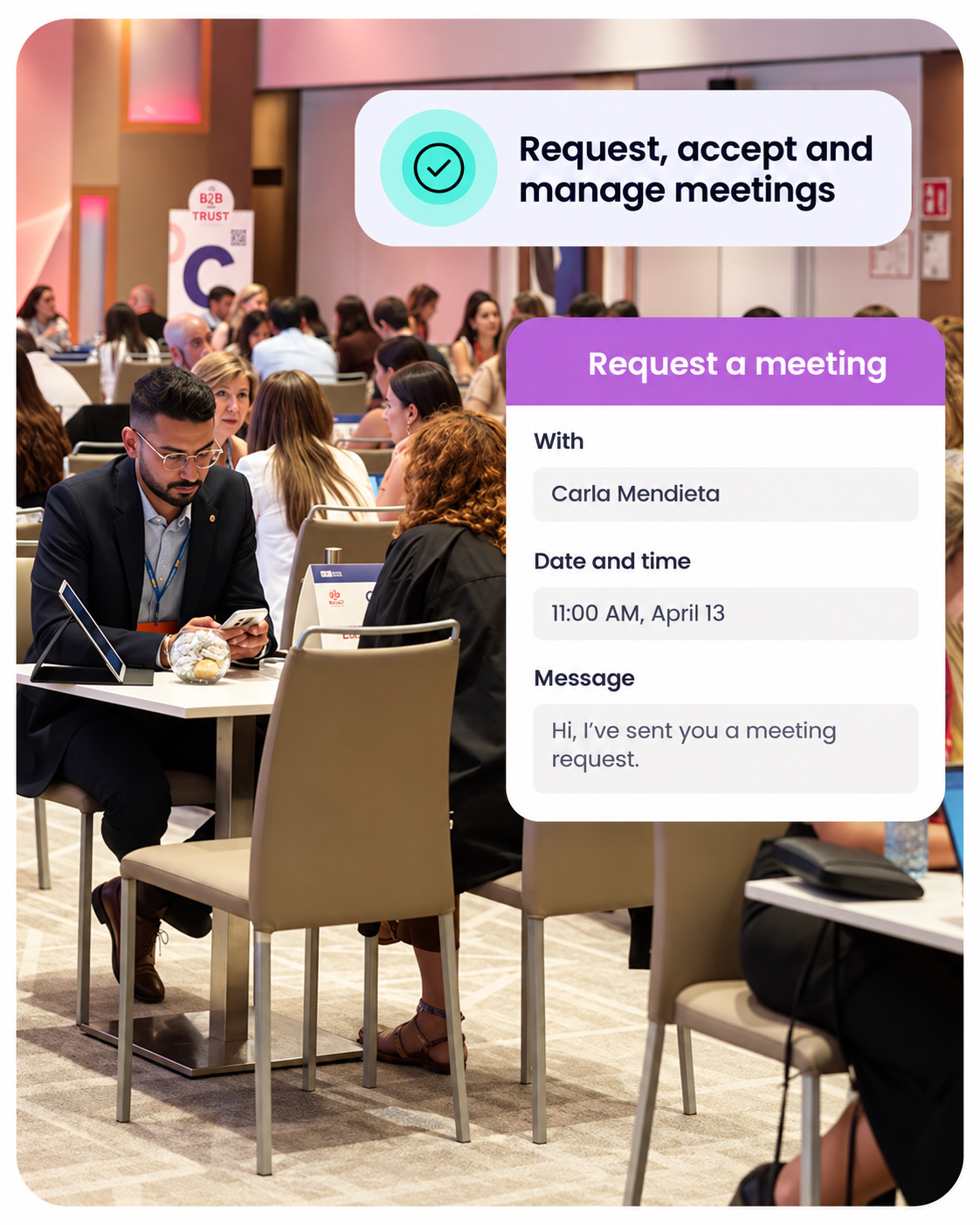
In an Open Meetings model, networking is open. Attendees access the participant list, identify the person they want to speak to, send a meeting request and the other attendee decides whether to accept it. Once accepted, the meeting is added to their schedule. With Meetmaps, this format allows attendees to request and accept meetings with one another without restrictions based on roles or profiles.
Imagine, for example, a marketing conference with 600 attendees. Laura sees that the Head of Growth at a company she has wanted to speak to for some time is attending. She checks their profile and requests a meeting for that afternoon. She doesn’t need the system to tell her they should meet: she already knows why she wants to talk to them.
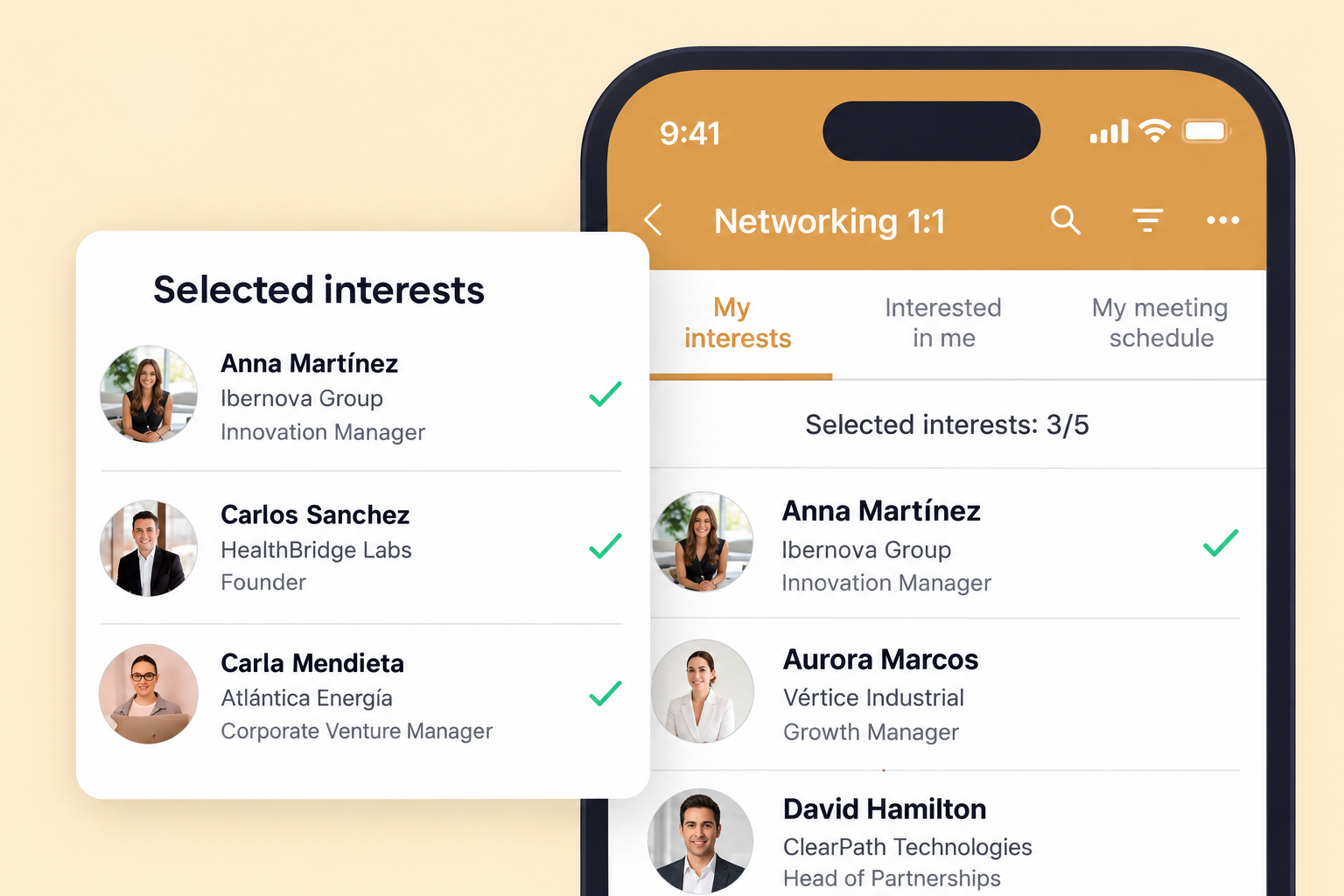
Matchmaking, on the other hand, introduces a greater level of curation. Instead of relying solely on spontaneous meeting requests, you can collect preferences or work with specific criteria to build a proposed set of meetings. Meetmaps, for example, allows attendees to indicate which profiles they are interested in and then generate a proposed meeting schedule based on that information and their availability. The planner can review it, make changes and publish it once it is ready.
This is especially useful when there are many participants or when there are groups with complementary objectives. For example, buyers who need to meet specific suppliers, startups meeting investors, or attendees with different roles who should connect during the event.
In short, the logic looks like this:
| Open Meetings | Matchmaking | |
|---|---|---|
| Who chooses? | Mainly the attendee | Preferences, criteria and the organizer |
| Dynamic | Exploration | Curation |
| How the connection starts | Meeting request | Preferences or matching |
| Schedule | Built from accepted requests | Generated according to criteria and availability |
| Planner control | Lower | Higher |
| Objective | Give attendees autonomy to discover profiles | Facilitate relevant meetings |
| Ideal for | Open events or professional communities | B2B events, hosted buyers or complementary audiences |
💡 TIP: think less about “which feature do I want to use?” and more about who should decide who each person meets. That question usually makes it much easier to identify which model you need.
When should you use Open Meetings or Matchmaking at events?
There is no universal answer here. And that’s exactly why it makes sense to start with the objective of the networking experience.
1️⃣ Open Meetings when you want to give attendees more autonomy
Open Meetings make a lot of sense when attendees know the event ecosystem well enough to decide for themselves who they want to speak to. They can work especially well at conferences, associations, professional communities or events where attendee profiles are relatively similar and there is no strong logic of “Group A needs to meet Group B.”
In these cases, the goal isn’t to tell attendees who their best contact is, but to make it easier for them to discover profiles and turn that interest into a specific meeting. And that’s the difference between Open Meetings and leaving networking completely unstructured. The connection still comes from the participant’s own initiative, but they no longer have to depend on bumping into that person during a coffee break. They can find them, request a meeting and reserve a specific time within the event.
Meetmaps allows this type of meeting to be managed through the App or Web, and attendees can choose who they want to meet and request an available time slot.
2️⃣ Matchmaking when the fit between profiles is part of the value of the event
There are other events where networking cannot depend entirely on each attendee exploring on their own. Think about a Hosted Buyer Program. You might have hotels, venues or suppliers on one side and buyers on the other. Or a startup event where certain investors should meet projects that align with their investment thesis.
Here, the value of the event depends directly on certain connections actually taking place. In these scenarios, matchmaking allows you to introduce preferences, roles or rules that help structure meetings more effectively.
👀 It also becomes increasingly valuable as attendee volume makes discovery more difficult. Manually browsing through 80 participants is one thing. Doing the same with 2,000 is something else entirely.
And the more important networking traceability becomes (who meets whom, which meetings are confirmed or how many actually take place) the more useful it is to work with a clear structure. Meetmaps allows you to centralize meetings, generate personalized schedules and check meeting statuses from the dashboard.
🧠 Remember: if the value lies in exploring, choose Open Meetings. If it lies in finding the right fit, choose Matchmaking.
Can Open Meetings and Matchmaking be combined at the same event?
Sí. Y, de hecho, en muchos casos tiene bastante sentido, porque un mismo evento puede necesitar estructura en unas conexiones y libertad en otras.
Imagina una feria B2B con hosted buyers. Puedes reservar determinados bloques para reuniones organizadas mediante Matchmaking entre compradores y expositores, asegurándote así de que las conexiones prioritarias tienen espacio dentro de la agenda. Pero una vez terminados esos bloques, quizá quieras permitir que los asistentes sigan descubriendo otros perfiles y solicitando reuniones adicionales por iniciativa propia. O pensemos en un congreso con distintos públicos. Podrías utilizar reglas de Matchmaking para facilitar encuentros entre determinados roles (por ejemplo, startups e inversores) y mantener un modelo más abierto entre el resto de asistentes.
Yes. And in many cases, it actually makes a lot of sense, because the same event may need structure for some connections and more freedom for others.
Imagine a B2B trade show with hosted buyers. You can reserve certain time blocks for meetings organized through Matchmaking between buyers and exhibitors, helping make sure that priority connections have a dedicated place in the schedule. But once those blocks are over, you may want attendees to continue discovering other profiles and requesting additional meetings on their own. Or think about a conference with different audiences. You could use Matchmaking rules to facilitate meetings between specific roles — for example, startups and investors — while keeping a more open model for the rest of the attendees.
Even within the Meetmaps Meetings ecosystem, there are different logics available: open meetings between attendees, meetings restricted by roles, meetings based on preferences or suggestions, and meetings linked to exhibitors. This makes it possible to adapt networking to the real structure of the event instead of forcing every participant into exactly the same dynamic.
And it is important to clarify that structuring networking does not mean removing spontaneity. It means deciding which connections you want to actively facilitate and which ones you would rather leave in the hands of attendees.
Ultimately, it is not about organizing more meetings. It is about designing how you want them to happen. There are events where attendees need the freedom to explore profiles and build their own schedule. Others where the planner needs to make sure that buyers and suppliers, startups and investors, or specific attendee roles genuinely have the opportunity to meet.
With Meetmaps, you can adapt 1:1 Meetings to the logic of your event: from open meetings between attendees to models based on roles, suggestions or preferences, while also centralizing meeting schedules and tracking activity from the Meetings dashboard. Because at the end of the day, having two people at the same event doesn’t guarantee that they will talk. What matters is designing the conditions that give the conversations that really matter a better chance of happening.
Not sure which model best fits your attendees? Talk to our team and discover how to design the networking experience for your next event with Meetmaps. 🚀