
Burnout in event planners is far more common than it seems. And honestly, it makes complete sense when you think about how event management actually works: tight timelines, last-minute changes, constant multitasking, operational pressure, people management, unexpected issues and the constant feeling that there’s always something left to do.
On top of that, within the industry it has often become normalized to always be “on”, to work under constant pressure or to assume that stress is simply part of the job. But there’s a big difference between organizing events that naturally include intense moments and permanently living in a constant state of alert.
Because when stress in event planning stops being occasional and becomes a constant dynamic, it starts affecting concentration, creativity, motivation and even the way you enjoy your work. That’s why more and more conversations around event planner mental health, emotional management and burnout are happening within the events industry. And not from a theoretical perspective, but from something very real: finding more sustainable ways of working without every project turning into an obstacle course based on survival mode.
That’s why in today’s article we’ll look at what usually causes event planner burnout, how to reduce stress in your day-to-day work and which tools can help you work with more control, less chaos and much smoother operations. Keep reading so you don’t miss anything!
What causes burnout in an event planner?
Most of the time, burnout doesn’t appear suddenly. It builds up little by little between events, constant changes, urgent requests and the permanent feeling of never truly finishing anything. Because in event planning there’s rarely a real pause: the moment one project ends, another one is already starting.
And this is exactly where one of the biggest problems in the industry begins: constant mental overload. Because it’s not simply about “having a lot of work”, but about having hundreds of small details taking up space in your head at the same time. Confirming attendees, adjusting timelines, checking suppliers, solving incidents, coordinating teams, answering messages or managing access control while continuously making decisions.
 In fact, many event planners end up working in a permanent reactive state, jumping from one urgent issue to another without enough time to stop, prioritize or regain focus. And when that dynamic lasts for too long, exhaustion stops being something temporary and becomes the normal way of working.
There’s also another factor that intensifies the situation even more: hyperconnectivity. Emails, WhatsApp messages, Slack notifications, calls, last-minute changes and constant alerts… The feeling of “always being available” becomes incredibly draining, especially during periods with multiple high-intensity projects or event-heavy seasons.
And the problem is that this doesn’t only affect fatigue: it directly impacts the way you work. Mistakes begin to appear, concentration drops, creativity decreases, frustration increases and there’s a constant feeling of putting out fires instead of working with clarity. And very often, that’s exactly when burnout appears.
How to avoid burnout in event planning
The truth is that there will probably never be a completely stress-free event organization process. There will always be unexpected issues, last-minute changes or moments of pressure, especially when working with tight timings and so many moving pieces at once. But as we’ve seen, there’s a huge difference between managing occasional moments of intensity and constantly feeling overwhelmed. And many times, that difference has more to do with how you organize and work than with the amount of work itself.
One of the most important things is stopping the attempt to control absolutely everything. Because in events, things will always change. The goal is not eliminating every unexpected issue, but creating a structure clear enough so that everything does not constantly depend on your own mental load.
- Working with realistic planning, clear timelines and well-defined processes helps reduce the feeling of chaos enormously. When you have visibility over tasks, responsibilities and priorities, you also reduce a large part of the mental pressure that tends to accumulate throughout event organization.
- Learning how to prioritize is also essential. Because not everything is urgent, even if it feels that way. And many times, trying to do everything at the same time is exactly what blocks productivity and increases stress even more.
In fact, one of the ideas repeated most often among professionals in the industry is that centralizing information and stopping depending entirely on memory frees up a huge amount of mental space.
- Delegating is also part of the process. Many planners feel they need to supervise absolutely everything for the event to go well, but trying to control every detail constantly becomes unsustainable in the long term. And very often, it creates the opposite effect: more tension, more mental blocks and less ability to react properly when a real issue appears.
- Another key point is learning how to disconnect. It sounds obvious, but in events it is incredibly difficult to separate work from rest. And when you never fully disconnect, neither your body nor your mind truly recover.
That’s why more and more professionals are talking about setting clear boundaries, avoiding constant responses outside working hours and intentionally reserving time to rest. Because yes: rest is also part of the job when you want to sustain intense projects for years without burning out along the way.
How does technology help reduce stress in event planning?
This is where technology can make a huge difference. While it won’t completely eliminate the pressure of organizing events, it can significantly reduce operational friction, mental overload and the feeling of having information scattered across too many places at the same time.
Because one of the biggest problems in many events is not only the amount of work itself, but the fragmentation of operations: the agenda in one tool, registrations somewhere else, emails separated, changes spread across WhatsApp and spreadsheets, badges managed in another system and metrics arriving from different platforms.
In the end, a huge part of stress in event management comes from trying to coordinate too many moving pieces at once without having a centralized overview of what’s happening.
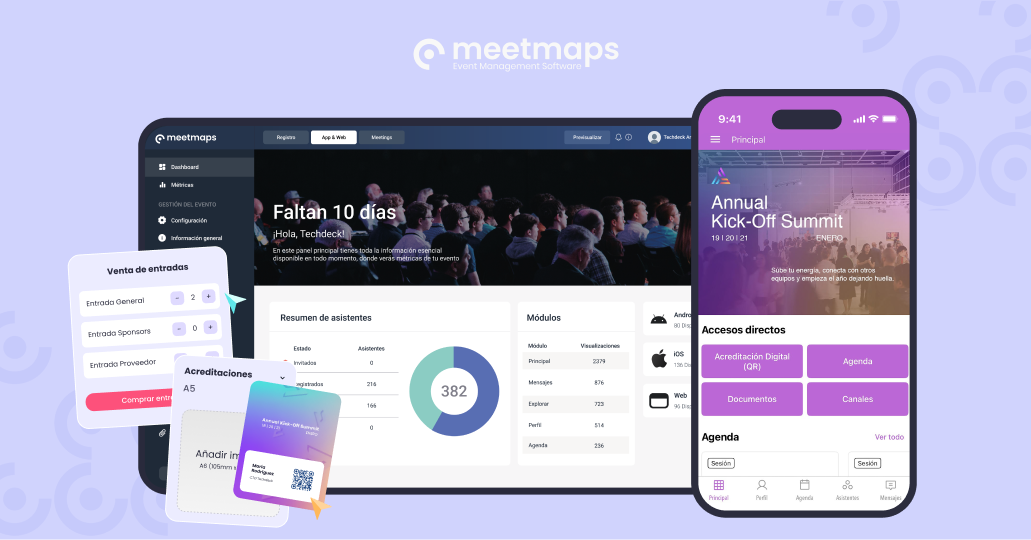
That’s why working with a platform that centralizes registrations, communications, check-in, agenda management, networking, meetings and metrics in one place massively simplifies the team’s day-to-day work: Because you reduce manual tasks, avoid duplication and gain much more visibility over everything happening in real time.
Automating certain actions also helps save time and reduce operational mistakes: automatic confirmations, segmented emails, onsite badge printing, real-time agenda updates or centralized communications allow operations to flow in a much more organized way and with far less dependence on improvised processes.
💡 When operations are more organized, the way the team experiences the event internally changes too.
For example, tools like Meetmaps allow teams to centralize the entire event experience: from registration and ticketing to 1to1 meetings, the event app, communications or access control, helping teams work with much more clarity and far less operational friction. Because when you have more control, more visibility and fewer repetitive tasks, you also drastically reduce the constant feeling of saturation.
Ultimately, organizing events will always include intense moments. There will always be changes, unexpected issues and days where everything seems to happen at once. But constantly working from a place of chaos, overload and the feeling of never catching up should not become the normal way of working.
Because at the end of the day, for an event to run smoothly, the team behind it also needs enough clarity, focus and operational calm to do their job properly. And many times, the difference is not about working more hours, but about having better processes, more visibility and less friction in everyday operations.
This is exactly where technology can create a real shift. Not only by automating tasks or centralizing information, but by allowing teams to stop wasting energy chasing updates, coordinating disconnected tools or constantly putting out fires.
With Meetmaps, you can manage registrations, communications, agenda, networking, check-in and metrics from a single place to work with much smoother and more organized operations. 🚀 Ready to get started? Request your demo and discover why so many planners love the Meetmaps experience. 🚀