
Índice de contenidos
B2B events bring together something very similar to what we find in any marketplace: on one side, companies offering products, services, solutions or collaboration opportunities; and on the other, professionals looking precisely for suppliers, partners, investment or new business opportunities.
But… bringing both sides together doesn’t necessarily mean they will actually find each other. You can have a trade show with hundreds of exhibitors and thousands of attendees and still have a buyer leave without ever meeting the supplier that best matched what they needed. And this is where the marketplace comparison becomes particularly interesting. On a digital platform, you wouldn’t expect a buyer to find the right product by chance. So why should it work that way at an event?
This is precisely where the planner’s challenge lies: understanding who belongs on each side, making it clear what some participants offer and what others are looking for, and facilitating the meeting points that can turn into real business opportunities.
That’s why, in today’s article, we’ll explore how to approach B2B events through the logic of supply and demand and the role that profiles, segmentation, networking and technology play in making that ecosystem actually work. Keep reading so you don’t miss anything!
How Do B2B Events Connect Supply and Demand?
The first thing to understand is that supply and demand change depending on the type of event.
- At an industrial trade show, supply might consist of manufacturers and suppliers, while demand comes from procurement managers or companies looking for specific solutions.
- At a startup event, on the other hand, you might have entrepreneurs on one side and investors or corporates on the other.
- At a MICE event, hosted buyers may be looking specifically for services offered by destinations, venues or specialized suppliers.
So, there is no single model. What they do share is a common logic: there are participants who are looking for something and participants who can offer it to them.
That’s why, to connect supply and demand at a B2B event, you first need information. You need to know who each participant is, which industry they represent, what they are looking for, what they can offer, what their interests are and what they hope to achieve by attending.
From there, you can facilitate discovery through attendee lists, filters or recommendations and, when there is a clear match, take the next step through 1:1 meetings or matchmaking dynamics. This is the logic used at professional events to connect buyers, suppliers, exhibitors and decision-makers through pre-scheduled meetings.
The difference is significant: you no longer simply have lots of companies gathered in the same place; you have enough information to help the right ones find each other.
How Can You Turn B2B Events into Marketplaces of Opportunity?
Thinking of an event as a “temporary marketplace” doesn’t mean literally turning it into a buying and selling platform. It means designing it with the understanding that its value increases when participants can more easily find what they came looking for. And to make that happen, several elements need to work together.
1️⃣ Balance Who Is Offering and Who Is Looking
A marketplace would lose value if there were high demand but very little supply (and vice versa). Something similar happens at a B2B event. Having 100 suppliers and only 5 qualified buyers will probably create a very different experience from having a more balanced mix. That’s why the goal isn’t to achieve the highest possible volume, but to attract sufficiently diverse and complementary profiles so that real opportunities for connection can emerge.
In fact, the very logic of marketplaces is based on both sides needing each other, with maintaining that balance being one of their main challenges. In the events industry, this means asking a fairly simple question from the very beginning of the attendee acquisition process: do we have enough relevant profiles for each of the audiences we want to attract?
2️⃣ Make the Supply Visible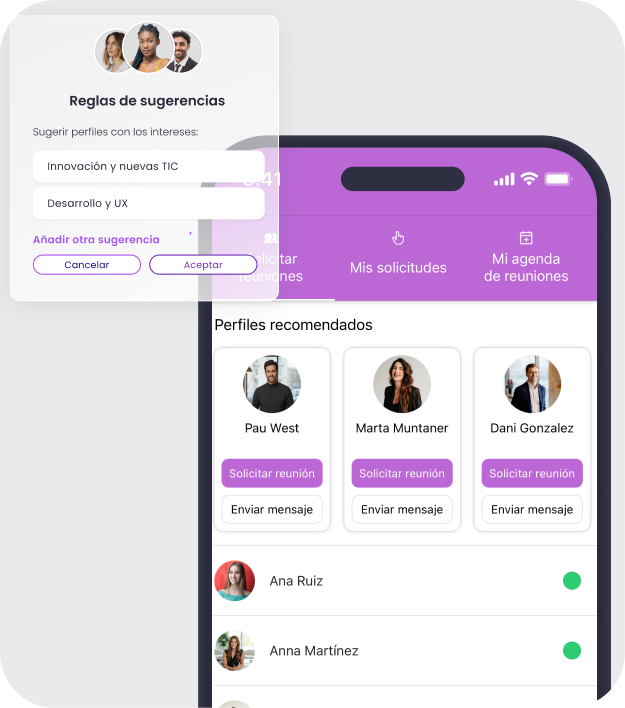
Company and exhibitor profiles need to help attendees quickly understand who they are, what they offer and why it might be worth talking to them.
There’s no need to turn every profile into an endless catalogue. Quite the opposite: the easier it is to identify the industry, value proposition, products or services and the people available for meetings, the easier it becomes to discover opportunities.
It’s the same logic we find in any digital marketplace: showing the right information helps people decide which options are worth exploring.
3️⃣ Understand the Demand Too
Making the supply visible is only one part of the equation. You also need to understand what the other side wants to find.
This is where the registration form itself can become a strategic tool. In addition to name, job title and company, you can collect information about interests, needs, networking objectives or the types of profiles each participant wants to connect with.
It’s not about collecting information for the sake of it. It’s about gathering the information that will later allow you to create better connections. In fact, with Meetmaps matchmaking, planners can collect participants’ preferences and then use them to suggest and organize meetings.
4️⃣ Facilitate the Meeting
Once you know who offers what and who is looking for what, you can make it easier for attendees with compatible interests to meet. With Meetmaps, you can create 1:1 meeting sessions, work with matchmaking and preferences, accept or reject requests and organize attendees’ meeting schedules automatically.
This isn’t about replacing the human side of networking. Technology works best precisely as the back office that helps make face-to-face meetings happen, while the conversation and relationship itself remain human.
5️⃣ Turn Interest into an Actual Meeting
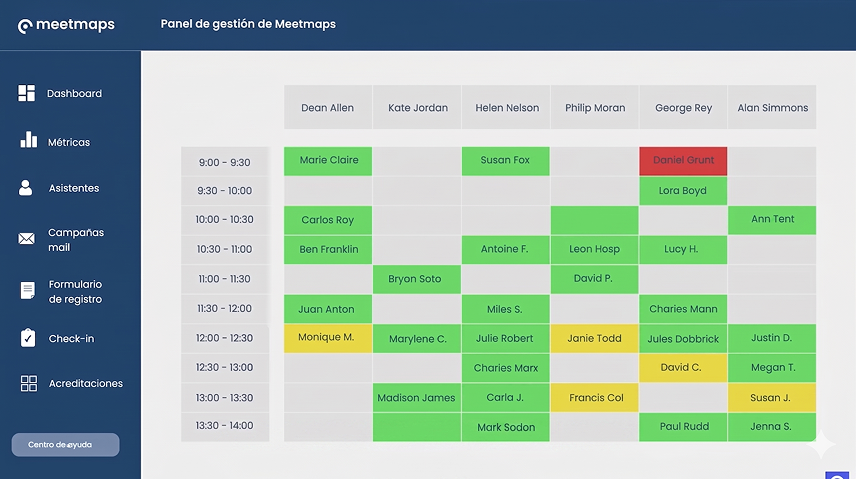
To make sure both sides actually meet, you need to coordinate availability, schedules, requests and spaces without turning the agenda into a manual puzzle.
Meetmaps allows you to generate a preliminary meeting schedule that the planner can review and modify before publishing it, while attendees can manage their preferences and meetings directly within the event environment. In other words, technology helps turn a potential match into something much more concrete: a place, a time and two people sitting down together.
6️⃣ Measure Whether the Marketplace Actually Worked
This is perhaps one of the most interesting parts. If we think of an event as a meeting point between supply and demand, simply measuring how many people attended doesn’t tell us enough: we also need to understand what happened between them.
How many meetings were requested? How many actually took place? Where were there no-shows? Which profiles generated the most activity?
Meetmaps allows you to check meeting statuses from the dashboard and track 1:1 Meetings activity in real time. Because an event with 3,000 attendees might look like a success on paper. But if the objective was to generate business, 200 relevant connections may tell you far more than the total number of badges issued. And that’s where the marketplace concept really starts to make sense.
From Bringing Companies Together to Helping Them Find Each Other
Ultimately, a B2B event creates value when it achieves more than simply having supply and demand inside the same venue: it needs to help both sides discover each other.
You can have the best suppliers, the right buyers and hundreds of potential business opportunities concentrated into two days. But if you don’t make it easier to identify those opportunities and turn them into conversations, much of that value will still depend on chance. And that’s precisely where the shift in perspective lies: don’t think only about how many companies you’ve managed to bring together, but about how many relevant connections you’ve helped create.
With Meetmaps, you can collect interests and preferences, structure B2B matchmaking processes, organize 1:1 meetings, generate meeting schedules and track networking activity from a single platform.
What opportunities could emerge if the right companies at your next event could find each other more easily? Talk to our team and discover how to structure those connections with Meetmaps! 🚀