
Índice de contenidos
We live in a constantly changing world. But if there’s one thing that hasn’t changed (even if formats do), it’s this: people attend corporate events to connect: to find clients, partners, talent, ideas… or even that one conversation that saves you three weeks of emails.
The problem is that many agendas are not specifically designed to activate connections. And the result is this: attendees crossing paths but not introducing themselves, coffee breaks where people only talk to those they already know, and networking that depends on whether you’re extroverted or not.
Because networking isn’t magic: it’s designed.That’s why in today’s article we’ll look at the types of networking that coexist in any event, along with 5 actionable strategies designed specifically to activate real connections.
So if you want to discover how to make networking more accessible and measurable, keep reading.
What are the 3 types of networking in corporate events?
Before designing dynamics to get your attendees to connect, you first need to understand what type of networking you want to create. In practice, there are three:
1) Spontaneous networking
 This is the “classic” type of networking: conversations that naturally happen in hallways, coffee breaks, queues, meals or afterwork. It’s valuable because it’s natural, but it has a problem: it’s not predictable. So if your event’s networking depends only on this, you’re essentially leaving half of its value to chance.
You can enhance this type of networking without forcing it in the following ways:
- Create spaces that invite people to stop (high tables, lounges, coffee points with room to talk)
- Schedule breaks after sessions that spark conversation
- Use signage that helps break the ice: topic-based tables, prompts like “what are you looking for today?”, etc.
2) Scheduled Meetings (1:1)
This type of networking is more focused on business: one attendee requests a meeting with another, a time slot is booked and confirmed. It’s the most efficient format for B2B events because it turns “we should talk” into an actual meeting.
This format works best in: B2B conferences, trade shows, partner meetings, exhibitor events, investment forums, talent events, etc.
3) Thematic gatherings
This is not a direct 1:1 meeting, but it’s also not leaving networking to chance. It usually takes the form of roundtables, workshops, challenge-based communities, discussion circles or meetups within the same event. They work because attendees connect through shared interests, lowering the social barrier.
Some examples: “CMOs in SaaS” roundtable, “Procurement & purchasing” group, “Seed-stage startups”, Practical workshop + mini debate.
What are the 4 Ps of networking in corporate events?
If you want networking at your event to truly work, there’s something else you need to understand beyond types: the 4 Ps of networking.
1) Person
Who is attending your event and what are they looking for? It’s not the same to organize an event for commercial profiles as it is for technical or institutional audiences. Segmenting your audience helps people connect faster.
💡 Keep in mind: attendee roles (buyer/supplier, client/provider, partner, press, talent…), their interests and their goals (learning, selling, recruiting, investing, collaborating).
2) Platform
Where will the connection happen? When you have a technological infrastructure designed for connection, networking starts to work as a system. By centralizing it in a well-structured platform, you can display attendee profiles, allow them to set preferences and interests, suggest relevant contacts and facilitate interaction through chat and meeting requests in just a few clicks.
3) Purpose
People connect better when there is a shared reason behind it. Your job as a planner is to provide that context: topics, challenges, sessions, event goals.
💡 Examples of well-communicated purpose: “The goal today is to leave with 3 actionable contacts”, “This session is focused on solving X challenge”, “These profiles are here to discuss Y”
4) Promoción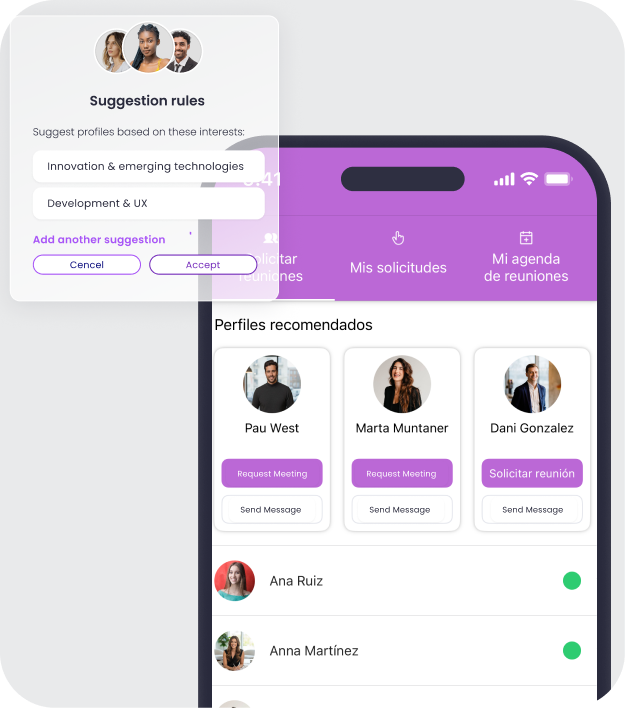
Networking starts before the event. In fact, 48% of attendees say networking is their main reason for attending. That means connections should begin days before. You can promote this by:
- Sending pre-event messages encouraging profile completion
- Offering recommendations and suggestions (based on configured parameters)
- Encouraging scheduling meetings
- Sending intentional notifications during the event
5 proven strategies to boost networking in corporate events
Now let’s get practical. Here are 5 highly effective tips to boost networking at your next event:
1) Introduction dynamics
It may sound basic, but it’s one of the most overlooked moments in event planning. What really makes a difference in how and when networking starts is having a clear moment where people introduce themselves.
And it doesn’t need to be complex, just something brief and well designed. At the start of the event, in a session or even in small groups, invite attendees to share who they are and what they’re looking for.
💡 For example: “Introduce yourself in 30 seconds and say what kind of connections you’re looking for today.” That small push changes the tone of the entire day. People stop “waiting to see what happens” and start actively looking.
2) Make it clear who is who
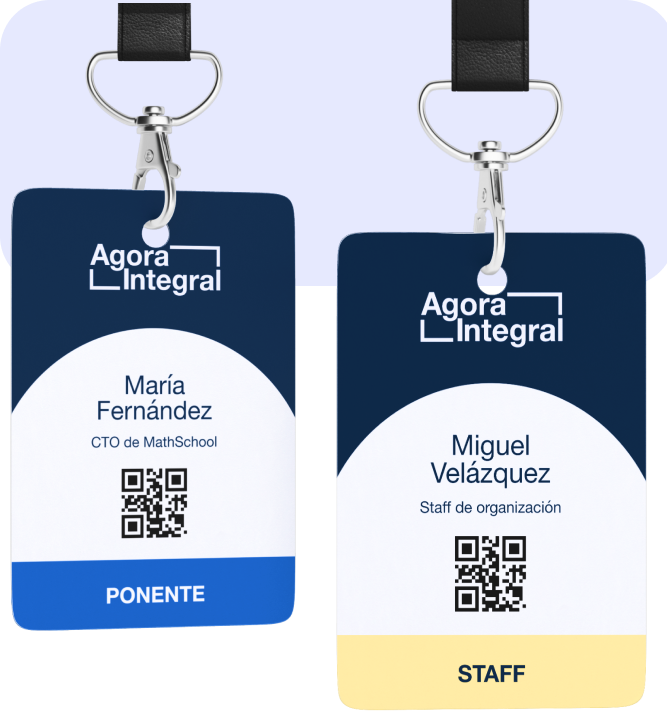
When all attendees wear the same neutral badge, networking becomes a guessing game.
Using differentiated badges by profile (buyer, supplier, partner, press, talent) reduces friction. If someone can instantly see whether the person in front of them matches what they’re looking for, the conversation starts earlier and more naturally.
3) Move from general networking to intentional micro-networking
Large “free networking” blocks work… but not because they are general. They work when smaller ecosystems exist within them. Instead of gathering 400 people and expecting them to organize themselves, create meaningful clusters: tables by challenge, role-based meetups, temporary micro-communities.
It’s not the same to say “now it’s networking time” as it is to say: “CMOs in SaaS meetup”, “Procurement & purchasing”, “Seed-stage startups”
When the context is clear, conversations happen naturally. People don’t connect “because they have to”, they connect because they understand why the conversation matters.
4) Structure time so networking doesn’t compete with content
One of the most common mistakes is packing the agenda so tightly that networking becomes a race against the clock. If attendees have to choose between talking to someone or making it to the next session, they’ll often choose the session, because it requires less effort.
That’s why you need to include real windows for networking in your agenda. Not as filler, but as a structural part of it. And if possible, place them after sessions that spark conversation. When someone has just heard a powerful idea, they are more inclined to discuss it.
5) Turn conversations into concrete next steps
If you want networking to generate real impact, introduce small dynamics that encourage action. It can be as simple as prompting attendees to agree on a next step after a conversation: a call, an email, an introduction, a demo.
You can also structure 1:1 meetings more intentionally (based on role, goal or interest), instead of random speed networking.
How to boost networking in corporate events with technology?
Technology doesn’t replace conversation. But it can eliminate the friction that prevents it from happening. This is where a well-designed infrastructure comes in:
- A well-designed event app turns networking into a system: It doesn’t just show who’s there — it shows why you should talk to them. Complete profiles, role filters, affinity-based suggestions, direct chat… all of this reduces initial friction and allows networking to start days (or even weeks) before the check-in.
- 1:1 meeting management: An integrated meetings module allows attendees to request meetings with specific time slots, receive confirmations and arrive at the event with a full agenda. As a planner, you can track how many meetings were requested, confirmed and where the real activity is happening.
- High-quality remote connection: If your event is hybrid, creating virtual networking spaces, integrated online meetings, thematic rooms or digital dynamics ensures remote attendees are not just passive viewers.
- Networking in your pocket: When agendas are personalized, notifications are strategic and suggestions are well configured, your event app becomes a constant facilitator. Add light gamification, and participation increases naturally. It’s not about turning the event into a game, but about activating movement.
So, technology doesn’t create networking. But it does create the conditions for it to happen faster, with less friction and more intention. An event where networking is structured feels different: more professional, more useful and more valuable over time.
If you want your event to generate real connections, start with the basics: segment your audience, create spaces, provide context and structure meetings. And if you centralize everything in one app (agenda, profiles, messages, meetings, hybrid features, access), networking becomes a measurable and actionable part of the attendee experience.
Want to activate networking at your next event without the complexity? Request a Meetmaps demo and discover why more and more planners trust a platform that turns connections into conversations… and conversations into results. 🚀